Self-leadership is one of the most overlooked skills in creative entrepreneurship and business growth.
If your business has felt harder than expected, or momentum keeps slipping away, this page will help you understand why.
Many creative entrepreneurs assume their struggle is a strategy problem.
But when growth won’t stick, no matter how hard you try (or how much you do), the real issue is self-leadership.
Self-leadership is one of the most overlooked skills in creative entrepreneurship and business growth.
If your business has felt harder than expected, or momentum keeps slipping away, this page will help you understand why.
Most entrepreneurs are taught to fix strategy first.
When a business isn’t growing the way you hoped, the instinct is to search for another way:
So you start adjusting things.
And sometimes those things help.
But many entrepreneurs still find themselves in the same cycle:
At that point, strategy isn’t the problem.
Self-leadership is.
Self-leadership is the ability to direct yourself with clarity and steadiness.
It’s the internal skill that allows an entrepreneur to:
Without self-leadership, even the best strategy won’t work.
With it, growth becomes steadier, clearer, and far less exhausting.
This realization didn’t come to me all at once.
For years, I assumed the challenges in my own business were strategy problems. If something wasn’t working, I believed I simply needed a better approach.
But the same patterns kept appearing — overthinking decisions, losing momentum halfway through projects, or second-guessing directions that had once felt clear.
Eventually, I realized the real issue wasn’t strategy.
It was how I was leading myself.
Most business problems are actually self-leadership problems
Entrepreneurship requires a kind of leadership most of us were never trained for.
Most of us were never taught how to lead ourselves.
At home, in school, and in traditional careers, success comes from following (not leading).
Those environments reward responsiveness — not self-direction.
But building a business asks for something very different.
There is no teacher setting the assignment.
No boss outlining the next step.
No clear benchmark telling you you’re on the right path.
You are the one setting the direction and making all the decisions.
You decide what matters.
You choose what to prioritize.
You stay with the work when results take time.
For many creative entrepreneurs, this shift is disorienting.
Not because they lack ambition or intelligence, but because the internal skill of self-leadership was never part of the curriculum.
Once that skill begins to develop, business growth feels very different.
Decisions become clearer.
Momentum becomes steadier.
And the work feels far less exhausting.
Self-leadership gaps usually show up as patterns — not obvious failures.
What you might be experiencing:
None of these are character flaws.
They’re signs that the internal structures of leadership haven’t been developed yet.
Entrepreneurs who practice self-leadership experience:
Self-leadership isn’t a set personality trait.
It’s a set of internal skills that can be practiced and strengthened over time.
Self-leadership isn’t something you read about once. Just like any skill, it’s developed through practice and repetition.
In my work with creative entrepreneurs, there are 5 essential practices for building the necessary skills.
They aren’t hard, but they are intentional.
Without these 5 practices, skills don’t develop, and steady business growth is impossible.
The five practices of self-leadership
1
Direction
Growth begins the moment you get clear about where your business is going and what matters most right now.
This includes the big picture (1 year+) and short-term (this month).
Without clear direction, any work done is just busy work.
2
Next Steps
Once your direction is clear, the next step is to translate it into simple, doable actions.
Many entrepreneurs get stuck here — holding big goals but lacking a clear path forward.
Self-leadership turns vision into practical, doable next steps.
3
Follow-Through
Ideas and plans don’t grow businesses.
Consistent follow-through does.
Self-leadership strengthens your ability to stay with the work long enough for momentum to build — even when motivation fluctuates.
4
Problem Solving
Every business (and entrepreneur) encounters obstacles.
Some are external: client issues, sick kids.
Others are internal: doubt, emotional volatility, limiting beliefs, or overwhelm.
Building problem-solving skills allows you to face both kinds of problems calmly, so you can resolve them rather than avoid them.
5
Reflection
Growth compounds when you pause long enough to see what’s working.
Reflection helps you notice patterns, refine your approach, and repeat the actions that create progress.
Without this, you’re constantly guessing about what works.
With it, your experience turns into wisdom and more effortless future growth.
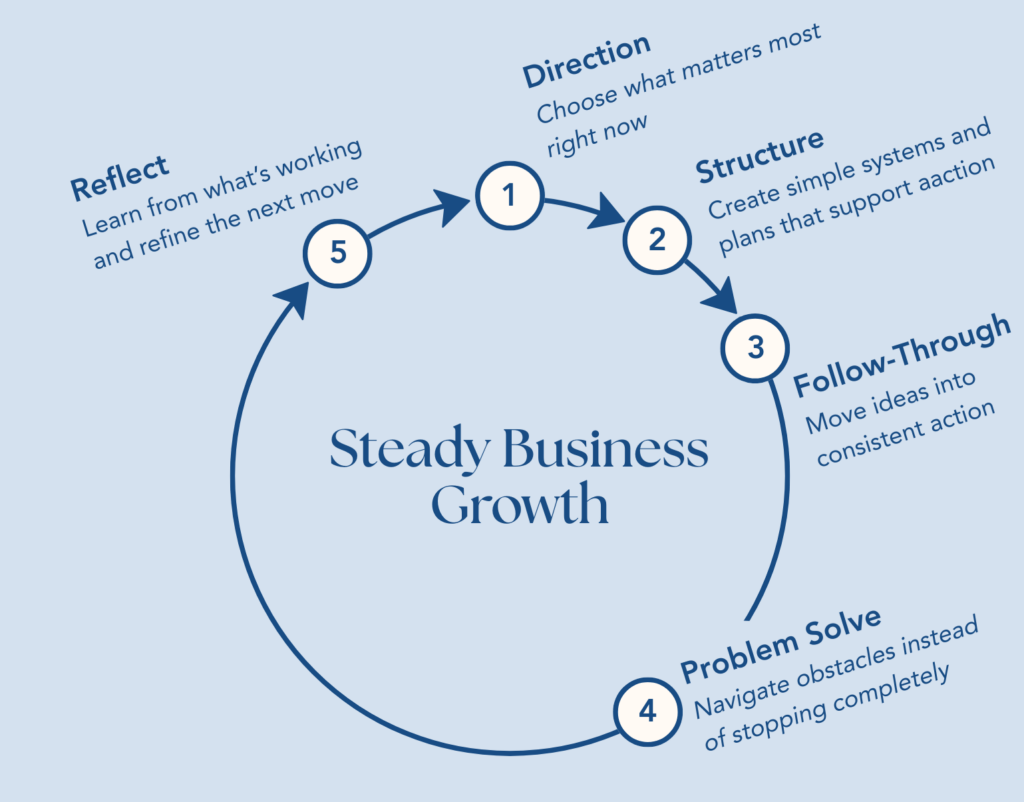
The five practices create growth when they work together as a cycle.
Each of the five practices strengthens an important leadership skill.
But the real power comes from how they work together.
When these practices operate in isolation, growth won’t work effectively.
But when the five practices work together in sequence, they form a leadership rhythm that steadily moves your business forward.
This repeating cycle is what causes growth to compound over time.
For example:
If you decide on a direction and set a goal, but don’t follow through, nothing changes.
If you follow through but don’t problem-solve when things pop up, you’ll get stuck along the way.
If you solve problems but never reflect on what’s working, you’ll constantly be reinventing the wheel instead of leveraging what works.
This cycle is the foundation of healthy self-leadership
Direction creates → focus.
Next steps create → movement.
Follow-through builds → momentum.
Problem-solving → removes obstacles.
Reflection turns experience into → future success.
When practiced on repeat, growth compounds.
The fastest way to grow is to pause and see where your self-leadership is breaking down.
If your business feels scattered, heavier than it should, or harder than expected, it’s time to pause and examine the internal side of leadership for yourself.
I created a short diagnostic to help you do exactly that.
It takes about three minutes and often brings surprising clarity.
A simple tool designed to help you see:
→ Download the Monthly Self-Leadership Reset
The reset walks you through each stage of the Self-Leadership Cycle so you can regain clarity and momentum.
Three ways to become a self-led entrepreneur and achieve sustainable growth that lasts
“We surpassed our revenue goal, but the real growth came in how I show up: more confident, clear, and grounded as a leader.
I now trust my voice, make decisions with clarity, and embrace my role as an expert in my industry!”
Adrienna McDermott
Ava & The Bee
“I definitely had my biggest revenue year ever. Even with the craziness of moving!”
Elisa Lessard
The Scrappy Wife
“I just kept saying, ‘I’m gonna do this,’ and it was not moving forward. I kept questioning, ‘Why is this so hard?’
Now, I podcast regularly! I’m taking all the steps that I need to, and I don’t feel resistance.”
Sam Pfotenhauer
Wild River & The Artist’s Rendezvous