A leadership practice that creates steady business growth
Most entrepreneurs assume growth comes from finding the right strategy.
So when progress stalls (or things aren’t working), they start changing things.
Offers.
Marketing.
Direction.
Hoping the next adjustment will unlock growth.
But growth doesn’t come from constantly fixing strategy.
It comes from the person leading it.
Without strong self-leadership, even good strategies fall apart.
This realization didn’t come to me all at once.
For years, I assumed the challenges in my business were strategy problems.
If something wasn’t working, I figured I must be doing something wrong — or that I needed a better approach.
So I tried new ideas.
Adjusted my plans.
Looked for the strategy that would finally make things click.
But the same patterns kept showing up:
Inconsistent revenue.
Internal chaos.
Feeling like I was on the wrong path.
Overthinking decisions.
Losing momentum halfway through projects.
Second-guessing directions that had once felt clear.
Eventually, I realized the real issue wasn’t strategy.
It was how I was leading myself.
Most business problems are actually self-leadership problems
Most business advice focuses on external tools.
Planners.
Morning routines.
Productivity systems.
Copying what successful people do.
Those things can sometimes help.
But if you’ve tried those things and they didn’t work for you, it’s because they rarely address the deeper issue.
Building a business requires learning how to lead yourself toward growth amid uncertainty.
That’s the skill most creative entrepreneurs were never taught.
Self-leadership gaps usually show up as patterns — not obvious failures.
Inconsistent revenue
Inability to think clearly
Feeling capable of more but struggling to make progress stick
Constantly revisiting decisions or directions
Overthinking nearly every move in the business
Starting projects with excitement, but losing momentum halfway through
Feeling like everyone else somehow got a blueprint you missed
None of these are character flaws.
They’re signs that the internal structures of leadership haven’t been developed yet.
It’s not your fault.
Entrepreneurship requires a kind of leadership most of us were never trained for. (In fact, we were trained for the opposite.)
In school and traditional jobs, the structure already exists — deadlines, expectations, someone telling you what matters most.
But when you build a business, you become the one creating the direction, making the calls, and staying steady when things feel uncertain.
And most of us were never shown how to do that.
5 Simple Habits
On my journey to discover what I was doing wrong in business, I started to notice something interesting.
In the coaching circles and business groups I was part of, the entrepreneurs who achieved steady growth (while seeming calm and clear) weren’t working harder. And they didn’t have the newest best strategies either.
They were practicing five leadership behaviors over and over again.
I’ve come to learn that without these five behaviors, healthy business growth isn’t possible.
Self-leadership isn’t a personality trait.
It’s a set of internal skills that can be learned and strengthened over time.
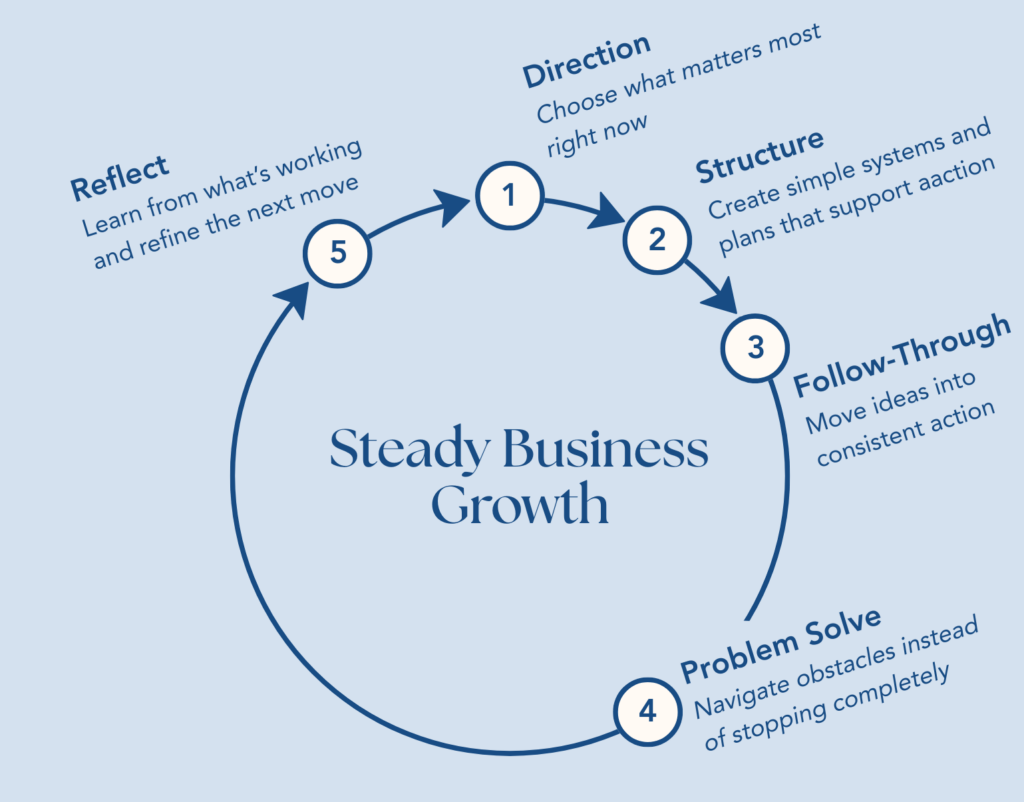
The five behaviors of self-leadership
1
Direction
Growth begins when you get clear about where your business is going.
2
Next Steps
Understanding which simple, doable actions move the needle.
3
Follow-Through
Ideas and plans don’t grow businesses. Consistent follow-through does.
4
Problem Solving
Every business owner encounters obstacles. Removing them helps you keep moving.
5
Reflection
Notice patterns, refine your approach, and repeat the actions that create success.
When practiced as a repeating rhythm, the five habits create clarity, momentum, and steady growth.
Over time, this rhythm becomes the internal operating system for how you lead your business.
I call it The Self-Leadership Cycle
When growth feels stuck, one part of the cycle has usually broken down.
Revenue is stagnant despite wanting growth.
You feel lost, not knowing what to focus on.
You’re doing a lot, but your effort is spread across too many things for momentum to build.
You keep changing direction before momentum builds
You feel busy but unsure if the work actually moves the business forward
It feels like you’re bumping up against an invisible wall
You’re longing for real momentum
You spend more time questioning what to do than doing it.
These patterns are common for creative entrepreneurs, and they’re exactly what the Self-Leadership Cycle is designed to solve.
Most business advice teaches the habits — but not how to practice them in the messy reality of creative work.
Creative entrepreneurs often have busy minds, strong emotional responses, and a constant stream of ideas.
But most traditional business advice assumes that once you choose a direction, you’ll simply stay clear, focused, and consistent.
Real creative work rarely unfolds that way.
There are doubts, competing ideas, emotional reactions, and moments where the path forward isn’t obvious.
Without an approach that accounts for that reality, the cycle breaks down — and growth stalls.
The key isn’t abandoning the cycle.
It’s learning how to apply it in a way that works with your creative mind rather than against it.
Self-leadership isn’t about doing all five practices every day.
The Self-leadership Cycle works best when it follows a steady balanced rhythm.
It doesn’t need to consume your life for it to work.
It just requires a steady rhythm and a clear process that removes the confusion.
I’ve found that a monthly rhythm works best to keep decisions clear, organized, and moving forward.
At the beginning of the month
You clarify direction and define the next steps.
During the month
Your primary job is to follow through and stay with the work long enough for progress to develop.
When obstacles appear
You shift briefly into problem-solving, then return to execution.
At the end of the month
You pause for reflection, learning what worked so the next cycle becomes stronger.
This rhythm protects your focus, reduces overwhelm, and allows momentum to build over time.
Instead of trying to manage everything at once, you move through the monthly cycle again and again — strengthening your self-leadership skills and creating business growth as you go
Business and personal growth!
“We surpassed our revenue goal, but the real growth came in how I show up: more confident, clear, and grounded as a leader.
I now trust my voice, make decisions with clarity, and embrace my role as an expert in my industry!”
Adrienna McDermott
Ava & The Bee
“I definitely had my biggest revenue year ever. Even with the craziness of moving!”
Elisa Lessard
The Scrappy Wife
“I just kept saying, ‘I’m gonna do this,’ and it was not moving forward. I kept questioning, ‘Why is this so hard?’
Now, I podcast regularly! I’m taking all the steps that I need to, and I don’t feel resistance.”
Sam Pfotenhauer
Wild River & The Artist’s Rendezvous
Understanding the cycle is the first step. Practicing it is where real growth begins.
The fastest way to build Self-Leadership is to practice it.
Understanding the cycle is one thing.
Learning how to actually practice it in the middle of a real business — with emotions, resistance, and competing priorities — is where most people get stuck.
That’s why I created a short guide to help you get started.
Start Here: The Creative’s Self-Leadership Quickstart Guide walks you through the most common mistakes creatives make when they try to apply the cycle on their own — and how to fix them.
get the quickstart guide
Inside the guide, you’ll learn:
It’s a simple introduction to practicing the cycle in a way that works with your creative mind instead of against it.
Download the guide and start applying the Self-Leadership Cycle this month.
[Download the Guide]
Actually, most creative entrepreneurs benefit from just enough structure.
The Self-Leadership Cycle isn’t about forcing yourself into a strict routine or pushing through resistance at all costs.
It simply creates a rhythm so different types of thinking happen at the right time — direction, action, problem solving, and reflection.
That rhythm tends to reduce overwhelm while protecting creative energy.
And emotions aren’t something to ignore in this process.
They’re often the clues that reveal the obstacles or insights that lead to real breakthroughs.
Self-leadership isn’t about pressure.
It’s about steadiness.
Most people assume discipline is the missing ingredient in their business.
But in reality, what’s often missing is structure that supports good decisions.
When the next step is unclear, when priorities keep shifting, or when problems appear without a way to solve them, even highly motivated people lose momentum.
The Self-Leadership Cycle reduces that friction by giving each stage of leadership a place.
Instead of relying on constant motivation, the system helps you focus on the right type of thinking at the right time.
Over time, that rhythm actually makes the business feel simpler to lead.
Not at all.
Creativity tends to thrive when there’s enough structure to hold it.
Without that structure, many creative entrepreneurs spend most of their energy rethinking decisions, second-guessing direction, or juggling too many ideas at once.
The cycle simply provides a container for creativity to move forward.
There’s space for exploration, adjustment, and new ideas — but they happen within a rhythm that allows momentum to build instead of constantly restarting.
That’s normal.
The goal of the cycle isn’t to trap you in decisions that aren’t working.
It’s to help you stay with direction long enough to learn from it.
If new information appears or something genuinely needs to change, the cycle naturally includes a stage for that — problem solving.
You address the obstacle or adjust the plan, then return to follow through.
This helps prevent the pattern many entrepreneurs experience where direction changes every few days before progress has time to develop.
Quite the opposite.
In this approach, emotions are treated as information.
They often reveal important clues about what’s happening beneath the surface — whether that’s a hidden obstacle, a limiting belief, or a strategic adjustment that needs to be made.
Self-leadership means learning how to listen to those signals thoughtfully without letting every emotional wave derail your direction.
That balance is what allows both progress and well-being to coexist.
The simplest place to begin is by experiencing an introduction to the cycle once for your own business.
You can download a short walkthrough that guides you through a simplified version of the Self-Leadership Cycle so you can see how the rhythm works in practice and start applying it to your business.
→ Download the Self-Leadership Monthly Walkthrough
The framework you just explored becomes powerful when you know how to apply each stage in real life.
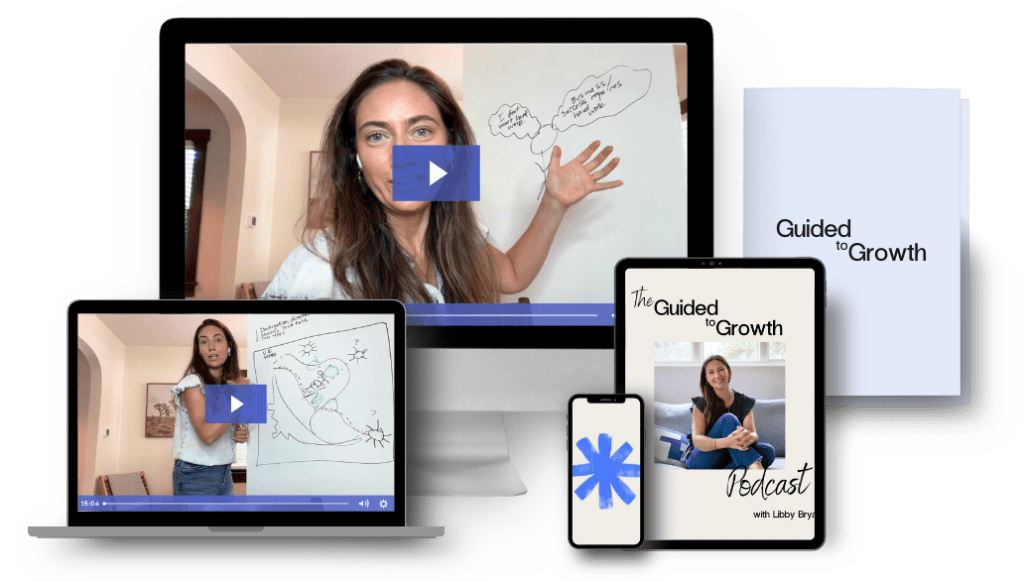
Inside Guided to Growth, I teach the full system and give you the tools that remove the guesswork.
The program includes templates, workflows, and guided exercises that teach you exactly how to practice the cycle until self-leadership becomes second nature in your business.
You’ll learn how to:
Get expert support and problem-solving as you apply the system. There are two additional ways we can work together.